
A Beginners Guide: What training load actually means in volleyball(and how to measure it)
Updated: Jun 5
By: David Gil

There are articles, videos, clinics and books written on various volleyball coaching and skill development. This will, inevitably, continue to evolve, sometimes devolve, but change is the constant.
Over the past 15 years, training load in all sports has come to the forefront, not just of coaching priorities, but a term fans have grown to know… and typically hate.
In this article we’ll review a bit of the history of training load, with a focus on volleyball. We’ll review the various ways to measure training load, strengths and weaknesses associated with these measurement techniques, and the silent impact that training load has had on the sport.
First, let’s get our terms straight and define training load. If you ask your resident AI, it will tell you, specific to volleyball, that training load is the total stress an athlete’s body experiences from training and competition.
To break down the meaning of training load, we need to first understand stress. Stress can be defined as physiological strain, which is made up of multiple different subcategories including neuromuscular, mechanical (or musculoskeletal), cardiovascular, and central nervous system (CNS) strain. Of course there is also psychological, or mental stress, which is another important aspect, but one we will save for a different discussion. While I recognize a number of terms have been identified here, bear with me because too often we skip these critical details in definitions and semantics. Lacking a foundational understanding of terms could mean missing out on opportunities to optimize athlete performance and mitigate the risk of injury; for example through the use of load management.
For the record, the aforementioned line is the goal of load management. And unlike the previous definition of training load, it requires no further explanation. However, in the event that you need the term broken down, it is exactly how it sounds: managing the amount of training for athletes, otherwise known as their training load. The journey to achieving said goal- optimizing athlete performance while mitigating injury- provides the challenge, so let’s get back to understanding the basis of athlete stress and how it can impact performance.
To better understand the relevance of load management and its applications, we first want to understand its foundational components. The forefathers of load management identified two main categories of physiological load: internal load (cardiovascular, physiological load) and external load (mechanical, neuromuscular load). Breaking these down will serve to highlight how practitioners and athlete advocates can work to measure load and better understand how monitoring training load can be implemented in order to achieve the goal of performance optimization and injury mitigation.

This is where we dive into a bit of history.
The first widely utilized and validated means of monitoring internal load was rate of perceived exertion (RPE). If you’ve dabbled at all in this field you will have heard of RPE. Perhaps you didn’t know what it stood for, but you did know it was a measure of player training stress.
This is considered an internal load metric, and a subjective one at that. There are a few different ways it can be calculated, but in a nutshell you take the score an athlete gives a training session, typically 1-10. Then you multiply that by the duration of the session to get an overall score that takes volume into account. 1-2 would be considered very easy, 3-4 moderate, so on and so forth. While some of a more objective data persuasion may hold their noses up at something so subjective and wrought with potential pitfalls, there is still more research supporting the proper implementation of RPE as a means of training load management than virtually any other method. Suffice to say, I always recommend RPE as an internal, subjective load metric that can help either validate or assist in the questioning of a coaches training plan.

Next, heart rate came into play. While this has never gained much traction in volleyball (a bit more in beach than indoor), it is still a very strong objective measure of internal load. Heart rate variability (HRV) is a favorite amongst practitioners. This internal load measurement can provide powerful insights regarding cardiovascular load, which, of course, will correlate strongly with mechanical load on the body.This is possible once baselines are set for each individual athleteIn volleyball, however, with a work to rest ratio of around 1:2.5 for women’s (closer to 1:2.8 for men’s), the bouts of activity are too short and the rest too frequent for it to accurately reflect the true demands of the sport. This is NOT to say it isn’t useful, but in a world of technology where we don’t want our athletes feeling like cyborgs, this as a single option is not the most effective.
Now to external load. This was first done in outdoor sports using GPS, which genuinely changed the way outdoor sports such as soccer, football, lacrosse and others are played. GPS is both ineffective and simply not all encompassing enough when you look at a sport where players move a matter of feet, rather than yards or meters. Additionally, indoors, GPS just doesn’t really work.
Next, along came ultra wide band (UWB). UWB gave us the chance to better track athletes' physical motion indoors, as it worked to resolve issues with pesky walls and ceilings blocking the signals that are needed to make GPS work. Still, as effective as this technology can be, distance traveled on the court for volleyball, while not useless, isn’t maximally useful.
At last, jump count was born. Like GPS in outdoor sports, jump count changed the way coaches plan practices around the world. It speaks to the main “stress” I hope you didn’t forget about during our walk down load technology memory lane. The primary stress in volleyball is neuromuscular and mechanical, where mechanical specifically refers to the volume and impact on athletes’ joints, muscles, tendons and skeletal structure. Like all sports at the highest levels, volleyball is not good for players’ knees, shoulders or back. Unique to volleyball though, is the all-important, always loved max jump. Jumping has always had a vicarious pull. While probably given most of its life from the feats of Sir Airness in the early 90’s, then promoted ad nauseum via our corporate overlords for decades, while social media and the NFL Combine continue to provide endless aspirational content. The jump is it. The ultimate feat of explosiveness and inextricably linked to the hardest impact action of our sport: landing.
This is why, in 2013, jump count became the load management metric of choice for the sport of volleyball. Again, this is not the end-all be-all load metric. For planning purposes, however, it's the most effective, easily understood and applied means of training load management practice to practice.
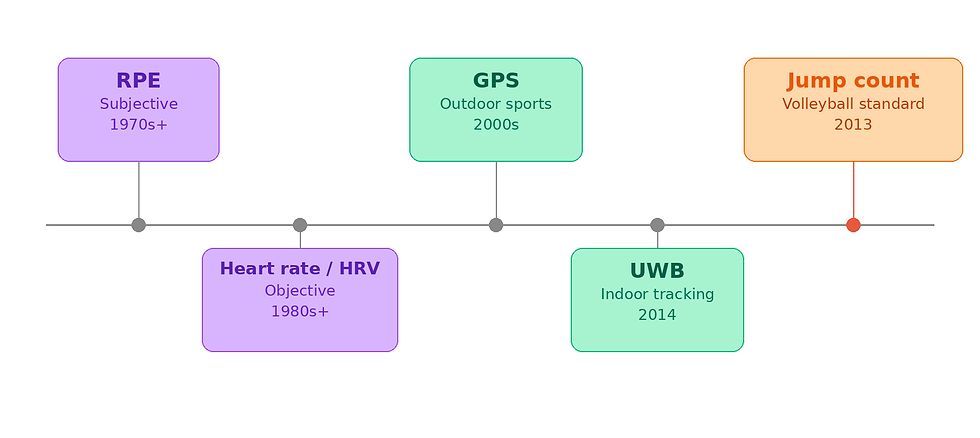
Now let us circle back to where we started: training load, or. the stress- be it internal, or external- on an athlete’s body based on his/her training or competition While we reviewed internal and external loads, we did not discuss psychological load and stress, primarily because this would lead to a drastically different discussion that pays tribute tothe countless hours of study and research by our sports psych brethren.
Acknowledging the impact of psychological load and stress is instrumental to understanding the overall training load an athlete endures. While it is not a main focus of this article, recognizing its relationship to landing impact is essential. We have witnessed increased internal load higher due to stress from finals. We’ve seen harder and higher landing impacts get harder due to stress from difficult class schedules. We’ve seen jump heights lower as a result of a broken heart (figuratively of course). Psychological factors are a critical part of an athlete’s overall load, and the stress felt off the court too often presents its shadow in the form of poor play, decreased mechanical efficiency and increased injury risk.
So as you search for ways to measure and assess your athletes’ training loads and begin planning your load management journey, first try to identify what it is you’re really trying to manage. Understanding your mission is the first critical component,and try not to let yourself get overwhelmed with the litany of metrics that you can analyze and follow day to day. Start small and focused. I suggest beginning withRPE and starting conversations with athletes to understand what level of exertion they feel they are expending during practices and conditioning. From here, perhaps you implement practices to track metrics like jump height/count and landing impact from a few members of each position. Gradually implementing and measuring various performance metrics creates a more complete picture of training load and naturally integrates effective load management practices into athletes’ regimens.
Once you have a plan and put it into action, you will see the fruits of thy labor. Players will be healthier. Your practices will become more intentional, and your team will inevitably be stronger for it.
For more information on the VERT Team System,
please schedule a demo HERE.
Join Volleyball Technology


I like games that do not make the interface unnecessarily complicated, and this one seems to follow that approach. The basic navigation feels simple enough for someone who is using the platform for the first time. There are different features to explore, but understanding each one is important before participating. My suggestion would be to start slowly, read the instructions carefully, and always keep gaming within a comfortable personal limit.
https://sikkimgamelogin.in.net/
That explanation of why counting jumps alone isn’t enough finally made it click for me. Context—intensity, rest, player position—changes what the number means, so raw totals only tell a fraction of the story.
<a href="https://nano-banana2.com/nano-banana-pro-vs-nano-banana-2
">nano-banana2</a>
It’s interesting that the clinics emphasize what athletes actually learn from the feedback, not just the data itself. I wonder whether those movement quality gains hold up during late-game fatigue, or if that’s still an open question for your team?
<a href="https://seedance2-5.org/
">seedance2-5</a>
I appreciate how you broke down the concept of training load in volleyball. It's so easy to get overwhelmed with stats! ragdoll playground How do you personally track your progress?
I find the development of jump count technology fascinating because it gives coaches a clearer way to monitor the physical stress athletes experience during training. I think understanding both jumping volume and landing impact can be especially valuable for protecting long-term performance. EaglerCraft is a completely different activity, but I appreciate how tracking and feedback can help people improve their skills more effectively.